
A pilot’s proficiency check expires in three weeks. A new batch of ground staff starts on Monday. An auditor asks for three years of crew training records. For an aviation training team, that is a normal week. Keeping it all on track is exactly what an LMS in aviation is built for.
Yet plenty of teams still juggle these dates in spreadsheets, email threads and paper files. It works, until one date slips through.
Not sure what an LMS actually does? This guide explains it in plain words: what it is, who uses it, the jobs it handles and what it cannot do.
The short answer: An LMS in aviation is software that plans, delivers and records training for pilots, cabin crew, engineers, airport staff and students. It sends the right course to the right person, tracks who passed what, warns before a certificate expires and keeps records ready for audits. It does not replace simulators or instructors. It organizes everything around them.
What Is an LMS in Aviation?
LMS stands for learning management system. Think of it as one online home for all of your training.
In aviation, that home holds:
- the courses each role needs, such as online lessons, videos, manuals and quizzes
- the schedule for classroom sessions and practical training
- the result of every exam and check
- every certificate, with its expiry date
- a complete history of who completed what, and when
So when a manager asks, “Is this engineer trained on the new procedure?” or “Which cabin crew are due for their annual refresher?”, the answer is a quick search, not a hunt through folders.
Why Does Aviation Training Need So Much Tracking?
Most industries train people once and move on. Aviation keeps training people for their whole career, and it has to prove it. Three things make it different.
1. Training comes back on a fixed clock
Under EASA rules in Europe, an airline pilot’s operator proficiency check is valid for 6 calendar months. The line check and the emergency and safety equipment training and check are valid for 12 calendar months. In the US, FAA rules say a required crewmember cannot serve on an airline flight unless they have completed recurrent training within the previous 12 calendar months. In India, the DGCA sets its own training and checking rules through its Civil Aviation Requirements (CARs).
Miss a date, and that person cannot be rostered for those duties until the training or check is done.
2. Records have to be kept, and shown
EASA requires airlines to keep records of each crew member’s training, checking and qualifications for 3 years. When an inspector visits, those records need to be complete, correct and easy to find.
3. The way people are trained is changing
Aviation is moving to competency-based training and assessment, or CBTA. Set out by ICAO, it trains and assesses people against clear performance standards instead of simply counting hours in a classroom. For dangerous goods training, this approach became mandatory on 1 January 2023.
Now multiply all of this by hundreds of people, dozens of roles and round-the-clock shifts. A spreadsheet can handle a small team. It starts to crack when one missed renewal can take a crew member off the roster or raise a red flag in an audit.
Who Uses an LMS in Aviation?
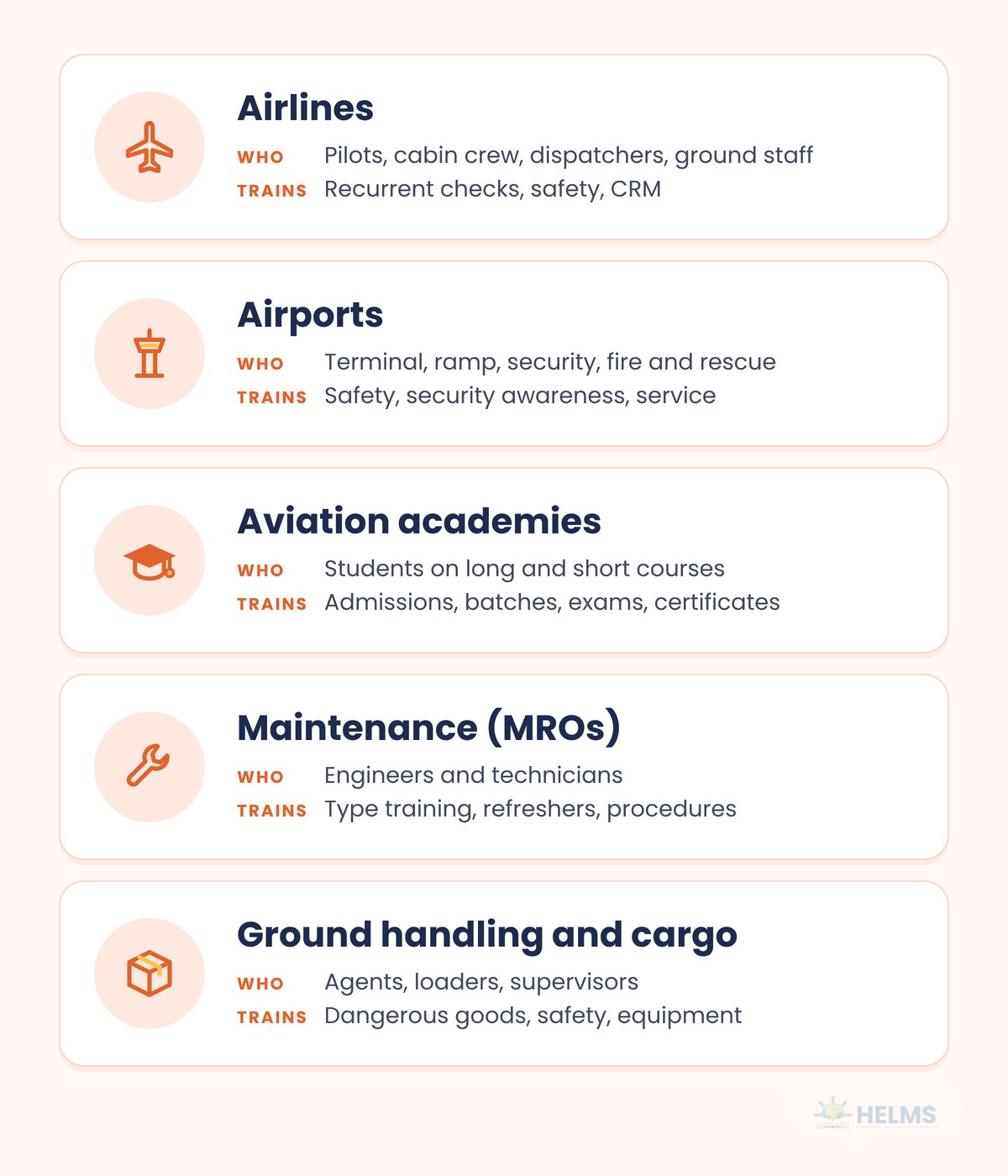
Almost every aviation organization trains people, so the list is long. Here are the main users and what they usually train.
- Airlines: pilots, cabin crew, flight dispatchers and ground staff. Recurrent training, safety and emergency procedures, crew resource management (CRM) and updates when a fleet or a rule changes.
- Airports: terminal, ramp, security, and fire and rescue teams. Safety, aviation security awareness, customer service and equipment handling.
- Aviation academies and flying schools: students on long programs and short courses. Admissions, batches, attendance, theory classes, exams and certificates.
- Maintenance organizations (MROs): engineers and technicians who need aircraft type training, refresher courses and the latest procedures.
- Ground handling and cargo companies: agents, loaders and supervisors, including dangerous goods training for staff who prepare or handle cargo.
What Does an Aviation LMS Actually Do? 7 Everyday Jobs
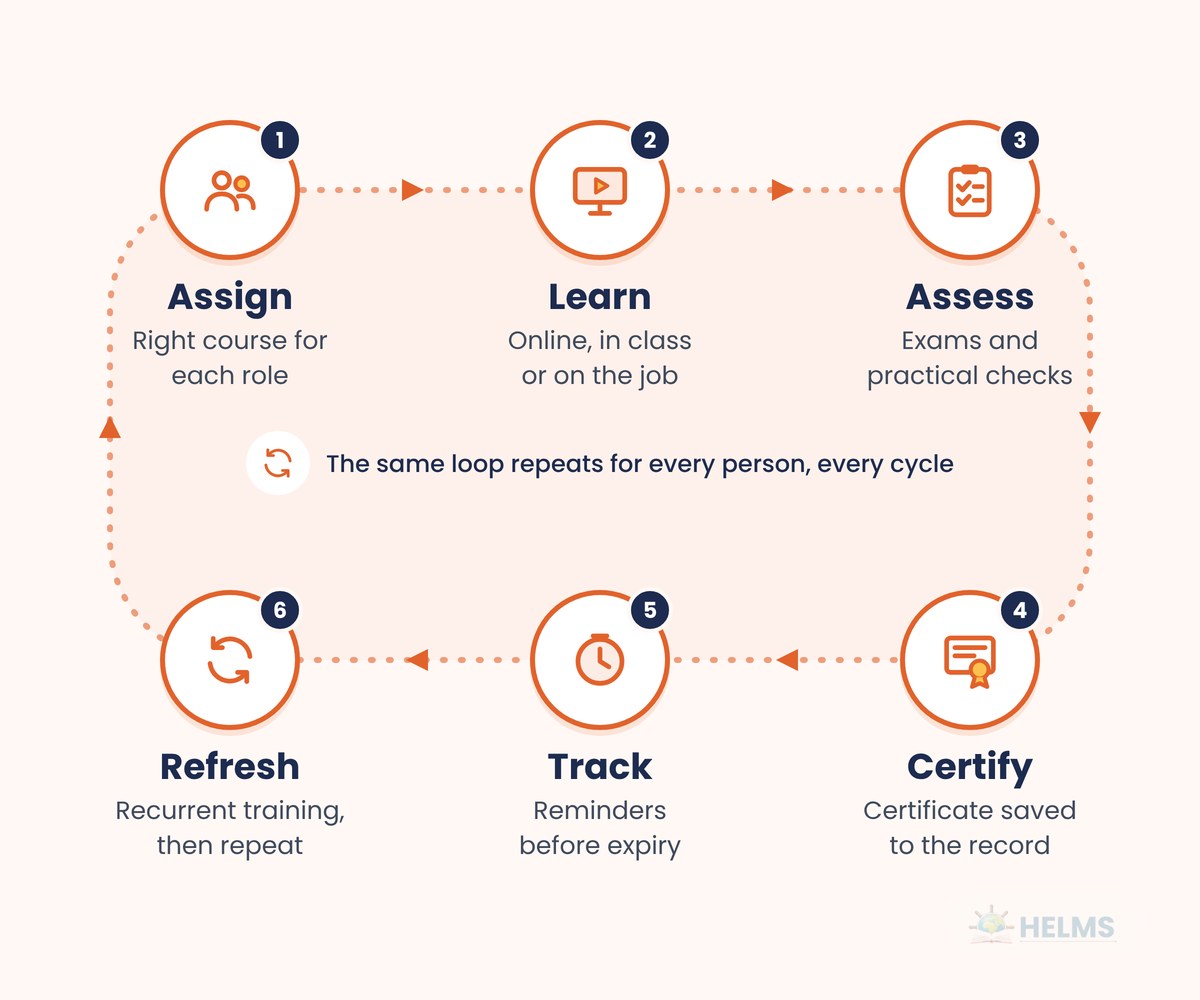
Here is what an LMS takes off a training team’s desk, roughly in the order it happens.
- Assigns the right training to the right person. A new cabin crew member gets an onboarding path. An engineer gets the course for the aircraft type they work on. Nobody has to send it by hand.
- Delivers the learning. Lessons, videos and reading material open on a laptop or phone, so people on shifts can learn when they are free. Classroom sessions are scheduled in the same place.
- Plans batches and tracks attendance. Academies and airports can create batches, set dates and mark attendance without paper registers.
- Runs exams and assessments. Question banks, time limits, pass marks and instant results. Instructors can also record practical assessments.
- Issues certificates and watches expiry dates. When someone passes, the certificate is created and saved. Before it expires, the system can remind the learner and their manager.
- Keeps audit-ready records. Every course, score, certificate and date sits in one history per person, ready to show an inspector.
- Shows the big picture. Dashboards tell managers who is trained, who is overdue, which courses people find hard and which team needs attention.
Put together, these jobs form a simple loop that repeats for every person, cycle after cycle.
What an LMS Does Not Do
An LMS is useful, but it is not magic. It helps to be clear about its limits.
- It does not replace simulators, aircraft or instructors. Flying skills, emergency drills and hands-on maintenance still need real practice. The LMS schedules that practice and records the results.
- It does not make a training program compliant on its own. The program, its content and its instructors still have to meet the regulator’s rules and approvals. The LMS makes the program easier to run and easier to prove.
- It is only as good as what goes into it. Clear courses, correct role mapping and up-to-date records matter more than any feature list.
How Do You Know Your Team Needs One?
You are probably ready for an LMS if a few of these sound familiar:
- Renewal dates live in a spreadsheet that only one person really understands.
- Every audit means days of collecting certificates from folders and inboxes.
- Night-shift staff struggle to attend fixed classroom sessions.
- You run several batches or sites and cannot see them all in one place.
- A renewal has slipped through the cracks at least once.
A Real Example From Kochi
CIASL Academy, the training arm of Cochin International Aviation Services Limited, has been preparing people for aviation careers since 2009. It uses HELMS to run both long-term academic programs and short-term aviation courses, with admissions, training, assessments, attendance and certificates in one system.
The Bottom Line
An LMS in aviation does one simple job well: it makes sure the right people get the right training at the right time, and that you can prove it. For airlines, airports and academies, that means fewer missed renewals, calmer audits and more time for real teaching.
Want to see what this looks like in practice? Here is how an aviation training LMS works for academies and airports.
Frequently Asked Questions
An LMS in aviation is a learning management system that plans, delivers and records training for aviation staff and students, such as pilots, cabin crew, engineers and airport teams. It tracks results and expiry dates and keeps training records ready for audits.
No. A flight simulator is where pilots practice flying and emergencies. An LMS is the system that schedules that training, stores the results and tracks when the next check is due.
No regulator asks for a particular software. The rules require that training happens on time and that records are kept and can be shown. An LMS is simply an easier way to do both when you train many people.
An LMS focuses on learning: courses, exams, certificates and records. A training management system usually focuses on planning resources such as instructors, classrooms and simulators. Many aviation teams need a bit of both, and some platforms cover both.
Yes. Even a small academy handles admissions, batches, exams and certificates. A cloud LMS lets a small team manage all of this without running its own servers.
Sources
- EASA, Easy Access Rules for Air Operations, ORO.FC.230 Recurrent training and checking
- EASA, FAQ n.47814 on crew records (ORO.MLR.115: training, checking and qualification records kept for 3 years)
- FAA, 14 CFR 121.433 Training required
- ICAO, Doc 9868, Procedures for Air Navigation Services: Training (PANS-TRG), Third Edition
- IATA, The competency-based approach to dangerous goods training and assessment
- CIASL, About CIASL Academy

Saurabh Angchekar
Digital Brand Strategist, ISF Group
Saurabh Angchekar is part of the ISF Group team, where he works across brand, content, digital initiatives and learning solutions, including HELMS. He focuses on turning complex ideas into clear, practical communication and building digital initiatives that help teams learn, adopt and grow across professional sectors.